 |
|
Advantages of the Limited-Payment Plan
Having referred to the shortcomings of limited-payment policies when viewed in the light of special circumstances, we may next note the conditions under which this method of paying premiums may prove desirable. Certainly, the willingness to pay a larger annual premium must be justified by advantages which will compensate for the sacrifice. Two important advantages present themselves and may be stated briefly as follows: 1. Premium payments may be limited to the productive period of life. Instead of continuing for an indefinite period, the premium-paying years may be so limited in number as to correspond to the income-producing years. Not only is there satisfaction for many people in knowing the maximum amount which they can be asked to pay on a policy, but for the great majority of men between the ages of 25 and 40, engaged in the average walks of1 life, the next thirty, twenty, or fifteen years, depending upon the age under consideration, represent the really productive period of their working lives. As regards the great majority, these years, and not the years of old age, can through a little extra effort and economy be made the years of surplus. It is therefore argued that the average man should take advantage of that period in his working life when money comes in most freely, to pay a somewhat higher premium, in order to free himself in old age from any payment whatever. Using the rates cited above, a person insuring at age 25 is given the option by the company of making his whole-life policy paid-up by the time he becomes forty-five years old by paying an extra annual sum of $7.75 per thousand dollars of insurance for twenty years. As previously stated, less than one in ten of our population succeeds in accumulating a reasonable competence by the time age 50 is reached, and through reverses in business or investments a great majority of this limited number lose the same before death. Now why not use the productive years, the supporters of the limited-payment plan argue, to protect one's insurance against such a contingency? As the management of one company admirably states in referring to a twenty-payment life policy: The period of twenty years is not so short as to make the discount of future payments too heavy, nor so long as to extend these payments far into the future, thereby defeating the wise purpose of avoiding them late in life. . . . After twenty years the insured has completed his side of the agreement and reaps the reward of prudence and persistency. His estate, the value of the policy, is an accomplished fact bought, paid for and standing to his credit. Nothing can take it from him, nothing can reopen the account it is beyond peradventure. At his death the company instantly discharges its side of the contract by the simple transfer of the property. . . . Here then, is a present plan for future security. The ordinarily vigorous and most productive years of life pay toll for the fullness of years sometimes attained without fullness of pocket. Thus the burden is put where it can more easily be carried, and the relief in later life always abundantly justifies the earlier foresight. 2. Combines saving with insurance. The limited-payment life policy affords the advantage of combining saving with insurance, assuming that the policyholder desires to accomplish this purpose, to an even greater degree than was noted in connection with whole-life insurance by continuous payments. The extent to which cash or loan values accumulate, for example, under a $10,000 twenty-payment life policy at age thirty-five is indicated for the first twenty-five years in the following table of values guaranteed by the same company whose cash and loan values were used for purposes of illustration in connection with an ordinary life policy: Guaranteed Values. Age: 35. Amount: $10,000. Annual Premium: $367. Plan: Life, 20 Payments, 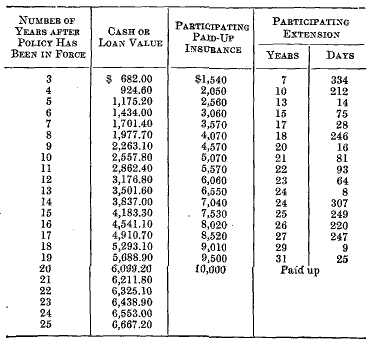
The values given above will be increased by any surplus or additions standing to the credit of the Policy. Comparing the above table with the corresponding table for an ordinary life policy (see Combines Saving with Insurance) we find that the premium charged on the $10,000 twenty-payment life policy at age 35 is $367 in this company as compared with $270 for the same policy on the continuous-payment plan. But it will be noticed that the larger premium on the limited-payment contract results in a much more rapid yearly growth of values under the policy. Whereas the cash or loan value given under the ordinary life policy amounts to $397.60 after the policy has been in force three years, the corresponding value equals $682 under the twenty-payment policy. Similarly, the cash or loan values of $1,460.10 and $3,275.80 under the ordinary life policy after it has been in force ten and twenty years respectively contrasts with corresponding values of $2,557.80 and $6,099.20 under the twenty-payment contract. This larger accumulation under the limited-payment plan is the result of the sacrifice necessary to meet the larger premium. Those supporting the plan argue that it encourages thrift and that the extra sum accumulated would not otherwise have been saved in the great majority of instances. The increased premium can, it is asserted, easily be paid by many if they only resolve to do so, with the result that a little determination will lead to the accumulation of a fund of large dimensions. |
|