 |
|
Necessity for Larger Premiums Under This Plan During the Premium-Paying Period
Since limited-payment policies require the payment of premiums during a term which averages less than the term of the contract, it follows that the annual level premium under this plan is larger than that necessary when premium payments continue throughout the life of the policy. The purpose of the plan is to have the policyholder pay an extra amount annually during the fixed premium-paying period so that after the termination of this period the policy may be carried to successful completion without further financial obligation on the part of the insured. Thus in the case of a limited-payment life policy., the ten, fifteen, or twenty premiums called for by the contract represent on the average a total sum sufficiently larger than the aggregate amount paid on the average during the same period under the continuous annual level premium plan, to enable the company to accumulate an amount which will be sufficient, together with compound interest earnings at an assumed rate, to carry the policy thereafter to its maturity without further charges upon the insured. While the mathematics underlying the computation of net premiums on the limited payment plan is referred to in Chapter XV, The Net Level Premium, the manner of applying the principle in actual practice may be illustrated by the following rates taken from the rate book of the company already used for purposes of illustration in the two preceding chapters. The rates presented are those charged by the company at various selected ages on a whole-life policy on the ten-, fifteen-, and twenty-payment plans, and the rates on the continuous-payment plan are also given so that a comparison may be made. Premium Rates to Secure $1,000 Payable at Death. 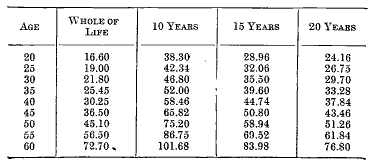
These rates are merely used for illustrative purposes. It should be noted that the gross premiums charged by different companies vary considerably, and that in mutual companies these premiums are considerably reduced through the distribution of dividends. An examination of the table shows that the fewer the number of premium payments the larger each payment will be. Thus at age 20 a whole-life policy with premiums payable until the policy becomes a claim will cost $16.60 in this company. If the insured, however, prefers to pay for the policy in twenty installments, each premium will amount to $24.16; while if paid in fifteen, or ten installments, the premium will increase, respectively, to $28.96 and $38.30, the last figure, it will be noted, being more than double the premium charged at this age under the continuous-payment plan. Owing to the heavier premiums the limited-payment plan is not well adapted to those whose income is small and whose need for insurance protection is so great as to require emphasis on the amount of protection rather than the accumulation of a fund with the company, especially when there is reason to believe that the income out of which premiums may conveniently be paid will be much greater in the future than it is at present. Furthermore, many policyholders, amply able to pay premiums, may feel that a policy requiring continuous payments will fit their needs better than a limited-payment contract, since it enables them to use the difference in the premiums to better advantage perhaps than if allowed to accumulate with an insurance company. Nor is the use of the limited-payment principle advantageous under the circumstances described in the chapter on "Term Insurance". Here we saw that situations may frequently arise which require the subordination of the investment feature in life insurance to its protective function to such an extent as to preclude or render disadvantageous the taking out of even whole-life insurance by continuous payments, much less the limited-payment plan. Especially is this true of young professional or business men who are just beginning their career and who, appreciating the necessity for adequate family protection, may feel that their special circumstances require the use of term insurance as a means of securing heavy protection at the least possible cost during the years when they are seeking to establish themselves in their calling. Such persons, as was stated., wanting heavy protection during early years, may feel that they can more advantageously use all available savings in their profession or business. Or, looking forward to a much larger income later in life, they may reason that they can then advantageously replace or supplement this type of contract with policies of other kinds which have permanent protection or saving as their primary purpose. It is also clear that the limited-payment plan will not appeal to those who desire protection against some temporary business or family hazard, the duration of which is definitely known. |
|