 |
|
Combines Saving with Insurance
Combines Saving with Insurance. Besides its moderate cost and the permanent character of the protection offered, the ordinary life policy furnishes the further advantage of combining saving with insurance. In term insurance, as already explained, nearly all of the premium represents payment for the current protection, and the companies follow the practice of not refunding anything upon withdrawal. Moreover, under term insurance nothing is paid to the insured in case of survival at the expiration of the term, and it is this fact that constitutes one of the chief objections to this type of insurance, it being most difficult, as previously stated, to make the average holder of such a policy, after he has paid ten or twenty premiums, appreciate the fact that he has already received full value in the form of protection for the premiums paid, and that he is therefore not entitled to receive any refund. As contrasted with this shortcoming, the ordinary life policy presents an entirely different situation. In the early years of such a policy the annual level premium is much in excess of the amount required to pay the current cost of the insurance protection, the balance being retained by the company as a reserve (called the legal reserve) and improved at compound interest at an agreed rate for the purpose of making good the deficiency in the later years of life when the annual level premium is no longer sufficient to pay for the actual cost of the insurance. The overcharges in the early premiums are instrumental in inculcating thrift on the part of the insured and in the great majority of instances, represent a saving an accumulation of small amounts promptly invested by the company which would otherwise not have been earned or, if earned, would have been lost or needlessly wasted. The fund thus accumulated out of the overcharges in the early premiums does not belong to the company, but is held in trust by it for the policyholder. It represents the " cash value " of the policy, and may either be withdrawn by the insured, in whole or to a certain designated percentage, if he decides to lapse the policy, or be made the basis of a loan, usually at 5 or 6 percent., to be used in time of illness, financial emergency, o0r business opportunity. The loan privilege also is often valuable in that it enables the insured to keep his policy alive for its full amount under temporary circumstances when the payment of the premium would otherwise not be possible. The extent to which such cash or loan values accumulate may be illustrated by the table on page 75, which furnishes the figures for the first twenty-five years of a $10,000 ordinary life policy issued by a company which grants such values at the beginning of the third year and to the full extent of the legal reserve. Guaranteed Values Age: 35. Amount: $10,000. Annual Premium: $270. Plan: Ordinary Life. 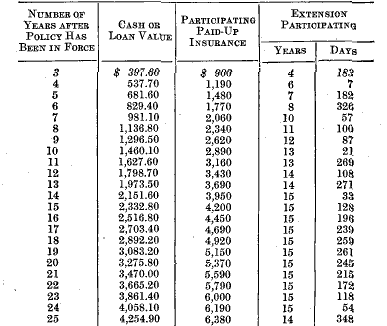
The values given above will be increased by any surplus or additions standing to the credit of the Policy. Usually cash or loan values are not granted by the companies until at least three annual premiums have been paid. Usually, also, the companies do not refund the entire legal reserve during the first ten, fifteen, or twenty years, but retain a fixed percentage thereof as a surrender charge. In the above illustration it will be observed that the cash value of the $10,000 policy has accumulated to $4,254.90 during the first twenty-five years, and this accumulation continues until it reaches the face value of the policy by age 96, the last year in the American Experience table. |
|