|
|
Loading and the Incidence of Expense
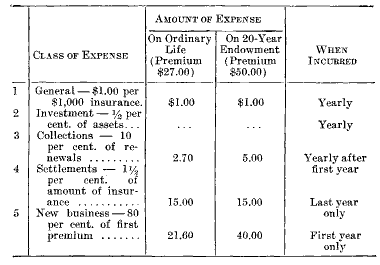
The problem of making each policy pay its own cost, as just discussed, is a matter of doing justice to each injured person. From the standpoint of the company, however, this factor is not of the same immediate importance as that of the incidence of expense, or the problem of meeting the expense when it occurs. If the office premiums charged for an ordinary life and a twenty-year endowment policy, each issued at age 35, are respectively $27.00 and $50.00 and if expenses are incurred on these policies in the proportion shown in the classified list of expenses on page 210 the following brief table will show the amount of expense and the time when it is incurred:
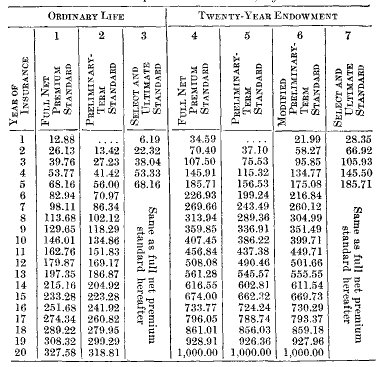
The net premiums on these two policies are $21.08 and $41.97, making the loading, or the amount available annually for expenses, respectively $5.92 and $8.03. These sums will easily provide for the annual charge of $1.00 for general expenses, for the cost of collections and will leave a surplus at the maturity of the policy to pay $15.00 for settlement of the claim. The investment costs, as already explained, are deducted from gross interest earnings and do not therefore affect the problem of loading. The last item, or cost of new business, that is .the cost of writing the policy, paying the agent's commission, medical examination fees, etc., incurs a total charge at the time of issuing the policy of $21.60 in one case and $40.00 in the other. Herein lies the great problem of the incidence of expense, for these policies; cannot pay their first-year costs from the loading available from the first premium. These expenses must be met when incurred and yet the company faces the necessity of maintaining the regular level office premium, of paying death claims at the close of the first year and of holding in reserve the remainder of the net premium. The net premium of $21.08 on the ordinary life policy at age 35 increased at 3 percent, interest accumulates to $21.71 at the close of the year. Of this amount $8.83 is necessary to pay the estimated costs of insurance for the year and $12.88 constitutes the reserve that should be held in anticipation of future claims against the policy. The loading is the only portion of the first premium that is available therefore to pay first year's expenses. For this reason a company cannot maintain its level office premium and hold the full net premium reserve from the start, and at the same time make every policy pay its own way. The first year's requirements are greater than the funds on hand. These first-year costs must be provided from some outside source, or some modification of the system of legal reserve valuations must be made whereby the reserve of the first year, or a portion thereof, can be used to pay them. For an old and well established company with a large surplus accrued the solution of the problem is comparatively simple, for it can pay expenses of new business from surplus and depend on replacing the amount from margins in the loadings of the later premiums. This, however, is not possible for new companies, for they have no surplus from which to borrow; and it results in slow growth of small companies, whose surplus is insufficient to supply the demands of a rapidly increasing business. One proposed method of meeting new business expenses as incurred and thereby making every policy self-sustaining ha; been to charge a cash initiation fee, or issue an interest-bearing note or lien against the policy to be paid by the application of dividends or in some similar way. But this plan has many practical objections, chief among which is the departure from the level-premium idea, and has never been favored by the companies. There exists the further possibility of dealing with this problem through some modification of the system of valuing reserves, whereby the reserve of the first year or of the first few years can be used to pay new business expenses. Three methods of modifying the full net premium reserves are used in the United States to-day, known respectively as preliminary-term, modified preliminary-term, and select and ultimate valuation. The germ of the preliminary-term idea was introduced into the United States from Europe, the product of a great German actuary, Dr. Zillmer. It provides that the first year's premium under any form of policy shall pay for term insurance for one year, and that the regular policy is to come into operation one year later than the date of issue, and will be for a term one year shorter. By this means the company is relieved of the necessity of establishing a reserve against the policy for the first year, and the entire premium becomes available for payment of current claims and expenses. This, of course, releases the first year's reserve for the payment of new business expenses. It becomes in effect a borrowing of the reserve for this purpose. On the ordinary life policy at age 35 the reserve thus released would be $12.88; on the twenty-year endowment at the same age, $34.59. The net premium for the later years of the policy is then increased. It becomes the net premium for an insurance issued at an age one year higher, at a date one year later and for a term one year shorter; and the reserves held on the policy for the second and later years are the reserves based on this new net premium, Thus an ordinary life policy at age 35 becomes a one-year term insurance plus an ordinary life at age 36; a twenty-payment life policy becomes a one-year term plus a nineteen-payment life at age 36; and a twenty-year endowment becomes a one-year term and a nineteen-year endowment at age 36. There are two fundamental objections to preliminary-term insurance as a method of meeting new business expenses. In the first place no distinction is made between ordinary life policies and limited-payment life or endowment contracts, and the company is permitted to spend the entire first-year reserve on the more expensive contracts for soliciting new business in the same way as the comparatively small reserve on the ordinary life policy. Thus, on a ten-year endowment at age 35 a reserve of $83.78 is released. This offers great temptation to company officials desiring to extend their business and in too many cases in the past has led to gross extravagance. If $12.88 in addition to the first year's loading is sufficient to pay new business expenses on an ordinary life policy it should not require a great deal more than this amount on any other kind of policy, and the company which uses the entire $83.78 on the ten-year endowment is misusing its funds. The second objection to preliminary-term insurance is that the company is given the entire premium-paying period of the policy to pay back this borrowed reserve. By considering the ordinary life policy in question as beginning only after the one year's term insurance expires and holding reserves on the policy as though issued at age 36, the reserves throughout the life of the policy are smaller than the full net premium reserves and, though the difference between them becomes smaller each additional year, they do not coincide until the insurer reaches age 96, when all reserves equal the face of the policy In other words, should the holder of an ordinary life policy valued on the preliminary-term plan die at any time before age 96 the company will not have entirely replenished the reserve borrowed for the purpose of writing its policy and the deficiency must be made up from funds which should be diverted to other uses. In the same manner with a twenty-year endowment the entire twenty years is given to replenish the depleted reserves; with a limited-premium policy the reserves will be brought up to the full net premium standard only upon the completion of premium payments. A comparison of the full net premium and preliminary-term reserves on a twenty-year endowment, as shown in the table on page 227, will reveal this defect very clearly. The first objection to preliminary-term valuation is corrected by the plan known as modified preliminary-term. It consists in making the ordinary life policy the basis on which borrowing from the reserve is permitted. But one rate is allowed for the term insurance at each age and this is the rate on the ordinary life policy at the next age, thereby permitting the net premium to remain level. For instance at age 35 the net premium for the one-year term insurance is equal to $21.74, or the net annual premium on a whole-life policy issued at age 36, and this entire amount is available for payment of expenses and death claims for the first year. The life policy begins the year following and the same premium of $21.74, being the correct net premium., payable from age 36, is paid thereafter and the regular reserve established for a policy issued at age 36. For contracts requiring higher premiums than the ordinary life the net premiums are determined as follows. On limited-premium policies they are equal to the net premium for the ordinary life preliminary-term rates at the same age plus a net premium sufficient to purchase a pure endowment maturing at the end of the premium-paying period for an amount equal to the difference between the preliminary-term reserve on the ordinary life policy at that time and the reserve on a paid-up policy. In other words the added net premium purchases a pure endowment sufficient to make the policy paid-up at the end of the premium-payment period. For endowment policies the net premium added above the ordinary life net premium is for a pure endowment sufficient to mature the policy, or a pure endowment for the difference between the face of the policy, $1,000, and the ordinary life preliminary-term reserve at the date when the endowment would mature. The table on page 227 shows that the preliminary-term reserve at the end of the twentieth year on the ordinary life policy issued at age 35 is $318.81. The reserve on the twenty-year endowment must, of course, be $1,000 at this time or $681.19 more than the above reserve. The net premium on the twenty-year endowment will, therefore, be equal to the net premium on the ordinary life plus a net premium sufficient to purchase a pure endowment of $681.19. A comparison of columns 4 and 6 of the table in question shows that modified preliminary-term valuation does not remove the second objection to preliminary-term insurance. A reserve is established the first year to be sure and it is higher throughout the life of the policy than on the full preliminary-term standard but it is consistently lower than the full net-premium reserve shown in column 4. The third method of valuation referred to, known as select and ultimate, takes advantage of a factor unheard of in any of the previous standards. This is the fact that net premiums are calculated on the basis of an ultimate table of mortality while the insured is subject to a select rate of mortality during the years immediately following the issue of his policy. Select mortality, as defined in Measurement of Risk in Life Insurance, is the mortality resulting among risks that have recently passed a medical examination. The effect of medical selection was found to last for about five years and mortality rates based on the experience of these first five years after medical examination are known as select rates. The experience of the later years is known as ultimate mortality, and it was on these latter data that the American Experience table was constructed. Therefore, a company basing its rates on the American Experience table will find that it has an excess of premiums during the first five years of insurance because the risk has been newly examined and is in the "select" class, A benefit naturally accrues to any company from the acceptance of risks thus subject to a lower mortality. But the first year of insurance is the year of high expenses. It is proper therefore to balance this select mortality against the high expenses and to allow the company the right to use the savings due to lower mortality in paying the necessarily high costs of writing the insurance. In this way every policyholder will be required to pay his own way in the company. The present valuation standards of the state of New York permit any company to use the benefits of fresh selection in addition to the loading on the first year's premium to pay new business expenses. The method of computing the present value of the assumed savings due to medical selection is too complex to consider here. The next table shows select and ultimate reserves on an ordinary life and a twenty-year endowment policy. The difference from the full net premium standard is marked the first year, of course, but is very small thereafter and the two standards coincide for the fifth terminal reserve. In other words, the select and ultimate method permits the company to borrow from the full net premium reserve a sum of money which will never have to be repaid because the mortality which would require it will never occur. But at the end of five years the company must hold the full net premium reserve on the policy. Herein lies the great difference between the select and ultimate method and the two preliminary-term standards; for with the latter the reserve never reaches the full standard until the policy matures other than by death, or until all premiums have been paid. The select and ultimate standard recognizes the benefits to the company of getting new policy-holders and permits the spending of the amount necessary to get them, but it does not allow this necessary expense to become a discredit by spreading itself over a long period of time. In actual practice there are many modifications of the systems of reserve valuations that cannot be considered here. The laws of New Jersey, for instance, permit the use of modified preliminary-term valuation but require the deficiency in reserves to be made good in seven years. In Canada the straight modified preliminary term may be used but must be made good in five years. The following table shows the actual reserves required to be held for twenty years according to the different standards herein explained, on an ordinary life policy and a twenty-year endowment insurance issued at age 35.
|
|