|
|
Methods of Loading
An equitable system of loading must, as stated, require every policyholder to pay the expenses which his policy costs the company, as nearly as this amount can approximately be determined. Since, therefore, certain expenses vary with the amount of the premium, they can be assessed equitably by making the loading a percentage of the net premium, this percentage to be of. such size that the company will collect in the aggregate sufficient loading to pay all expenses of new business and collections. General expenses and settlement costs, since they do not vary with the amount of the premium, but are a proper charge against the face value of the policy, can be provided for by adding to the net premium a constant sum per $1,000 insurance. This constant must likewise be so fixed that the aggregate collected from all policies will pay all general and settlement costs. The two methods of loading here described are known respectively as the percentage and the constant methods. They have both been used in the past, sometimes separately, sometimes in combination. Nowadays the loading systems commonly used are modeled closely on one of the following: (1) a straight percentage addition to the net premium, often varying the percent, for the higher premium policies; (2) a modified percentage loading, the usual method of which is the addition of a certain percentage of the given rat premium and the same, or sometimes a different, percentage of the net ordinary life premium at the same age; and (3) a constant and percentage loading, whereby the net premium will be increased by a constant amount per $1,000 insurance on all policies and at all ages plus a percentage of the given net premium, or of the net premium and the constant. The conclusions to be drawn from the analysis of expenses made at the beginning of this chapter are that loadings should increase as the amount of the premium increases, since some expenses are dependent on the size of the premium; but they should not increase in the same ratio, since there are some expenses which do not vary with the size of the premiums. The following tables show the effect of loading on the different bases named. In each case the American Experience 3 percent, net premium has been used, and the loading of gross premiums has been computed for specimen ages on an identical policy and for different kinds of policies at an identical age, the last column in each case showing the percentage of the loading charge to the gross premium.
The amount of the total loading on the different policies and at the several ages at once reveals the defect of this plan. The more expensive policies should stand a greater share of the loading charges but do not. The older ages and the more expensive policies are, therefore, favored at the expense of the younger policyholders and cheaper contracts. The simplest form of percentage loading is to add the same percentage of the net premium to itself for all policies and all In the illustration 33%, is used.
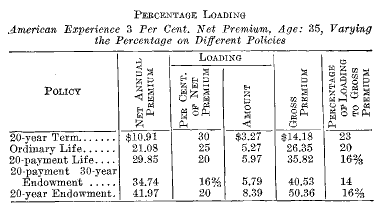
By this method the total loadings increase for the higher-priced policies, but a glance at the last column., showing the percentage of loadings to gross premiums shows that the ratio of loadings to premiums remains constant. This is unfair to the older ages and higher-priced policies since, with certain expenses remaining constant, the ratio of loadings to total premiums should decrease as rates go up. Some companies attempt to make an adjustment between different policies by varying the percentage loading as, for instance, 30 percent, on term, 25 percent, on ordinary life, 20 percent, on limited-payment life and on endowments, and 16% percent, on limited-payment endowments. The following table shows the results of this method on the five policies used:
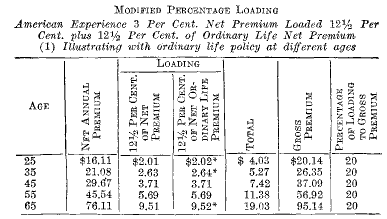
A comparison of total loadings and of the ratio of loadings to premiums here shows a progressive increase in the amount of loading as premiums increase, combined with a decrease in the ratio of loading to premiums. The exception is the limited-payment endowment. This plan is flexible, since by varying the percentage in any case further adjustment is possible. Below, the net premium is loaded 12% percent, plus 12% percent, of the net ordinary life premiums at the same age.
Total loadings here increase with increase in age and with the more expensive kinds of policies; but a glance at the last column of the first table shows that the ratio of loadings to premiums does not decrease as desired with the advance in age. Were the results computed for limited-payment life or endowment policies at different ages these ratios would actually increase with age. This plan, therefore., while making possible approximate adjustments between policies, does not adjust loadings equitably between young and old entrants. In spite of its defect, there is probably no other method of loading so generally used at the present time as this. The constant and percentage method, as stated, adds a constant plus a percent, of the net premium, in the illustration a $2.00 constant plus 20 percent. This method seems more nearly to approach the result desired than any other. Total loadings increase with premiums but the ratio of loadings to premiums decreases and equity is thus preserved between different ages and different policies. It will be understood of course that the additions made in each case above are merely illustrative of the methods used and that the percentage or the constant actually added by a company to its net premiums must be made with reference to the actual expenses of the company. |
|