 |
|
Construction of the Mortality Table
The table as given above represents the mortality data in its final form for use in expressing probabilities of death and of survival. It is manifestly impossible for any insurance company to insure a group of 100,000 persons of exactly the same age and at exactly the same time, and it is equally impossible to keep any such group under observation until all have died. Insurance policies are written at all times of the year and on lives at various ages. It is entirely practicable that a record be kept of all insured lives, showing at each age the number of persons under observation, and of those observed for one year at least the number who have died. If data are collected, therefore, showing (1) the age at which persons come under observation, (2) the duration of the period of observation, and (3) the number dying during one year, for each age, the materials will be furnished, out of which a mortality table may be constructed. Suppose, for illustration, that statistics have been collected as follows : 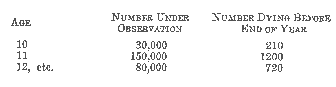
From these figures death rates may be computed for the respective ages in the following manner : 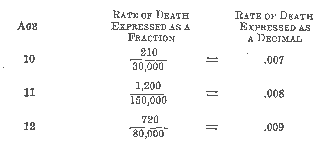
Death rates may be so computed for each separate age to the maximum limit of life, if only the data are collected as required above. If these figures can be considered as representing the yearly probabilities of dying 3 for persons of each given age, a mortality table may be constructed from them by assuming a group of say 100,000 persons at the youngest age. for which it is desirable to compute the table and then reducing the group by reducing the number yearly according to the given figures of the probabilities of death. The following simple table will illustrate this method: 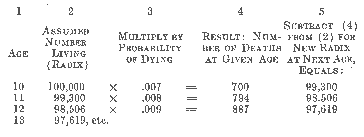
Since the probability of dying at age 10 is .007, there will occur 700 deaths during the year among the 100,000 starting at age 10, this leaves 99,300 of the group to begin age 11 and this latter number dies at the rate of eight per thousand (.008), making 794 deaths during the year. In this way the original 100,000 are reduced by deaths year after year until all have died. Thus is the statement true that the mortality table represents "a generation of individuals passing through, time". In the mortality table shown on page 132 the two columns denoting yearly probabilities of death and of survival represent the final form of the actual statistics of dying among insured lives. These probabilities were then applied to the assumed population of 100,000 at age 10, in the manner herewith explained, and the result was the American Experience table of mortality. |
|