 |
|
Assumptions Underlying Base Computations
When the problem of rate computation is approached it will be found that several questions at once present themselves, the answers to which will exercise much influence upon the results to be obtained. For instance, how is the premium to be paid? Is it to be paid in a single sum which will cover the risk for the entire period, as is the case with most kinds of insurance contracts, or will periodic payments be made annually, semi-annually, or otherwise? Again, when is it to he paid? In case of annual premiums, will they he paid at the inception of the risk and annually thereafter, or will some other time be found? Further questions are: What will be done with the money between the time it is received and the time it is paid out? How will mortality rates be determined for periods of less than one year duration in case, for instance, monthly premiums are decided upon, since the standard mortality tables give nothing less than yearly rates of mortality ? And, finally, when will death claims be paid? Clearly these questions must be answered before beginning the computation of rates; and their answer will furnish a method of procedure in rate-making. Premiums may be paid in a single cash sum, called the "single premium", which pays for the entire risk incurred during the life of the policy, or they may be paid in periods ranging from one week to one year. Most policies are purchased by an annual premium. When actuaries first set themselves to the task of computing premium rates they laid down the following working rules: (1) premiums will be paid in advance; and (2) matured claims will be paid at the end of the policy year in which the policy matures. Accordingly, if a policy is purchased by a single premium this sum is to be paid at the inception of the risk; in the case of annual premiums the first payment is to be made on the date of issue of the policy and equal amounts annually thereafter on the anniversary of this date. This assumption squares with the actual practice of insurance companies for it is an invariable rule to require the payment of the first premium at the time the policy is issued. In fact the law of contracts makes the payment of a consideration a prerequisite to the beginning of the risk. It is clearly evident in the case of single premiums, and it is true only in lesser degree with annual premiums, that the company will have the money on hand for some time before being called upon to pay it out again in satisfaction of matured claims. The question of the use of the money in the meantime therefore arises. This money is invested and made to earn interest while in the company's possession, and it is proper that regard be had to these interest earnings as one source of the fund available to pay claims. But since the company does not know in advance what rate of interest will be earned it is necessary to assume a rate which is reasonably certain of being earned each year throughout the long life of the policy. And since much of the premium money received by the company is held for a number of years before being paid out in the form of matured claims it will be possible to earn interest on interest. The importance of compound interest accumulations to an insurance company is evident from the following figures showing first -the amount of money obtained from investing $1,000 at different rates of interest for fifty years; and second, the amount of money which must be invested in the beginning to equal $1,000 in fifty years, at different rates of interest: 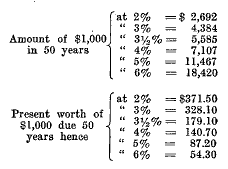
In other words, if six-per-cent interest can be guaranteed on an investment, $1,000 may be put away now and at the end of fifty years it will have accumulated to $18,420; or in order to pay a debt of $1,000 fifty years hence it is necessary to put away only $54.30 and earn compound interest on it at the rate of six percent. These facts are highly important to the insurance company, which is often called upon to keep policies in force for fifty years. In determining the interest rate to be assumed in computing premiums it is necessary to select a rate which the company is sure of earning every year over a long period of years. The assumption that 6 percent, could be earned would most surely be disastrous, for while the company might earn that rate in a prosperous year, this period might be succeeded by a business depression and through decreases in earnings and in the market value of securities or real estate the company would fail to earn the assumed 6 percent rate and it would be called upon to replenish its inadequate earnings from surplus or, in the absence of the latter, might be forced into bankruptcy. This makes it necessary for the company to assume a rate of interest which can be earned even in times of business depression. The first premium rates used in the United States were based on a 4 percent interest assumption and this rate has been very generally employed in cases where the Actuaries' table of mortality was used to compute premiums. With the American Experience table a rate of 3 percent, has generally been used until recent years. Since about the year 1900 a number of companies have been using a 3 percent interest assumption. Where policies are made participating it makes little difference what rate is used so long as it is not too large, since all money earned above the rate assumed is returned to the policyholder in the form of dividends; and the lower the rate used the better will a company be able to weather a period of financial depression. The second rule referred to above stated that matured claims would be paid at the end of the policy year. Some time must clearly be determined upon in order to know how long the money will draw interest before being paid. If it can be assumed that there will be a fairly even distribution of deaths throughout the year then on the average deaths will occur at the middle of the year. The payment of claims, then, based on this assumption, would occur six months after death. In the early experience of life-insurance companies this was not far from the truth, for it took about three months to make proof of death, and old policies allowed the company three months, after proof before "the claim was payable. At the present time, however, due largely to the factor of competition, claims are paid promptly, one prominent company, for instance, advertising that over ninety-five percent, of its claims are paid within one day of receipt of proofs of death. The importance of this consideration lies in the fact that the company loses nearly six months' interest on the sum paid. For, if deaths occur on the average at the middle of the year and proof of death requires one week, as is likely to be the case nowadays, the claim is paid on the average at nearly the middle of the year. But by the assumption used in computing the premium the money is supposedly held until the end of the policy year. Computing premium rates at 4 percent., this would mean a loss of $20 on a $1,000 policy. The assumption that claims are paid at the end of the year, however, is maintained in the face of this fact for two reasons: (1) because of the great amount of labor and expense involved in computing new tables based on the more correct assumption; and (2) because the mortality table, as explained in the Measurement of Risk in Life Insurance, allows sufficient margin to cover this deficiency and make the position of the company perfectly safe. Another assumption made by the companies in their rate computations is that the death rate is uniform throughout the year. Thus, if out of 100,000 persons of a certain age 600 die within one year, the assumption is that fifty die the first month, fifty the second month, and so on during the year. The fact is that the death rate is constantly decreasing up to about age 10 when it begins gradually to increase, and this increase continues at a constantly accelerating rate to the end of life. This assumption is of financial importance to the company only in case of policies paid for by premiums at intervals more frequent than one year. In the case of annual premiums, since all premiums are paid in advance, the money is on hand at any time during the year to pay insurance costs. In the case of monthly premiums, however, if only one-twelfth of the annual premium is collected in advance, but one-sixth of the total year's mortality should occur during the first month, the company will not have the funds on hand to pay losses. This situation can occur only during the first ten years of life when the mortality rate is constantly decreasing and it necessitates special treatment in case of insurance of children under age 10. But after age 10 the mortality rate is increasing and the discrepancy between the assumption of uniform deaths and the actual situation is favorable to the company and therefore presents no dangers, for the company will now collect one-twelfth of the premium, but will experience less than one-twelfth of the year's losses during the first month. |
|